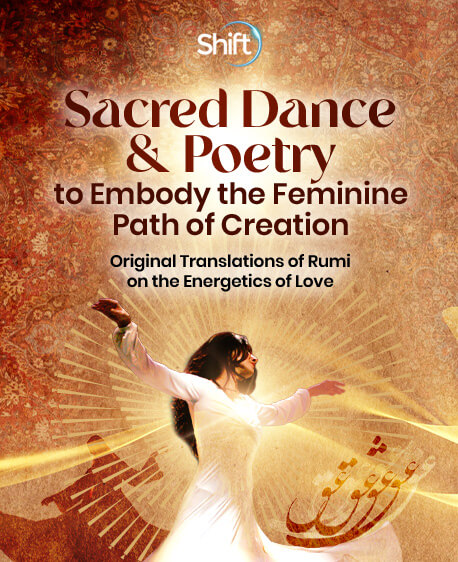
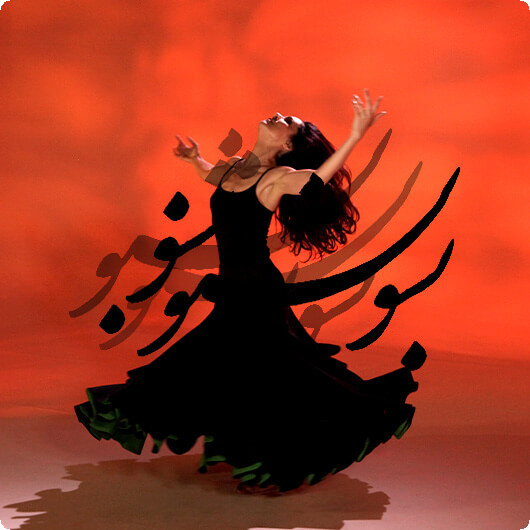
During this inspiring event, native Persian speaker and sacred dancer Banafsheh Sayyad will translate original Persian poetry by Rumi, a 13th-century Sufi mystic, into English...
... and guide you through a sacred dance sequence to embody one of Rumi’s poems as a prayer, which promises to return you to love and stability in times of turbulence, challenge, or uncertainty.
Most of us in the West and around the world have only ever read translations of translations of Rumi’s work — interpreted by those who don’t read or speak the Persian language. Not surprisingly, much of Rumi’s original meaning was lost in the process.
In contrast, Banafsheh’s translations restore the integrity of Rumi’s poetry, as in the following example:
This breeze at dawn is a confidant of secrets.
Don’t go back to sleep.
It is the time for prayerful yearning and tender need.
Don’t go back to sleep.
For all who dwell in both worlds,
from eternity past to eternity to come,
the door has never been closed — it stands wide open.
Don’t go back to sleep...
The interpretation below by a popular American poet, while certainly beautiful, reveals a distinct shift from Rumi’s original meaning:
The breeze at dawn has secrets to tell you.
Don’t go back to sleep.
You must ask for what you really want .
Don’t go back to sleep.
People are going back and forth across the doorsill
where the two worlds touch.
The door is round and open.
Don’t go back to sleep.
The fact that we universally sense the deeper meaning of Rumi’s poetry in our hearts as a sanctuary for the deeper yearnings we hold, reflects the love, truth, and coherence that is divinely encoded in Rumi’s work.
Banafsheh teaches that this unifying power is love... the force that grounds us and guides us through turbulent and polarized times. She offers us not only the original words of Rumi but the deeper context of his culture, life, and time as inspiration and guidance for living joyfully, conscientiously, and abundantly in modern life.
In a time of widespread chaos, uncertainty, and crises, we often try to harden ourselves to find balance, resolve, and strength. The feminine path and Rumi’s own approach to the immense turbulence of his time remind us that we don’t need to toughen up to make it through or make a difference...
In fact, lasting positive changes happen through soft power — when we center ourselves in our hearts, ground our intention in love, and open to guidance rooted in the higher vibrational way of being that we hope to create.
During this soul-enriching hour, you’ll explore how love is a field of creation that unifies humanity through a deeper vision of goodness, equality, justice, and peace...
... a vision that we can offer through our gifts, and collectively nurture and birth into our world through sacred dance — just as Rumi’s poetry flowed through him as he whirled in the embrace of the Divine.
Whirling offers an embodied experience of the wisdom and love suffused in Rumi’s poetry that can illuminate your unique role in helping to birth a new humanity.
Banafsheh teaches that to fully understand the poetry of Rumi and receive its timeless blessings, we must whirl just as he did when he channeled his words from the Beloved.
This artful, energetic approach to consciously shape our dreams and our world is a feminine lineage of healing and transformation Banafsheh was initiated into through direct wisdom transmissions from the spirit of Rumi and the Divine Feminine, who has guided her personal journey into healing, wholeness, and self-expression. This lineage took form as Dance of Oneness.
Rumi was born in 13th-century Iran (present-day Afghanistan) during a time of profound turbulence, yet chose to illuminate a path to love and inner transformation — what he stood “for” rather than energizing what he was “against.”
Forced into exile as a child by the invading Mongol Empire, and later shattered by the loss of his beloved companion and teacher, Shams of Tabriz, Rumi was plunged into the pain of separation and the sacred longing that would alchemize through whirling into a loving elixir for all.
Banafsheh’s lived experience mirrors that of Rumi’s — themes of exile, separation, and union with the Divine, and a personal longing for sacred self-expression in a country that forbade it — and has fueled her path to living love and serving the greater good.
This journey with Banafsheh, as well as her feminine methodology for healing, creation, and elevating consciousness, brings awareness and compassion to the paradoxes within us, helping us bridge our inner divides and create, together, this same divine alchemy.
If you feel called to a new, energetic way of transforming inner and outer grief, pain, and turmoil into peace, freedom, and aligned action, join us.